
Murrieta Genealogy Records
Murrieta genealogy records document family histories through vital records maintained by Riverside County and local historical collections in the Temecula Valley. Birth certificates, death records, and marriage licenses for Murrieta residents are processed by the Riverside County Assessor-County Clerk-Recorder office. Murrieta incorporated in 1991 after decades as an unincorporated Riverside County community. The city grew from a small hot springs resort town to a major suburban community during the 1990s and 2000s. Riverside County Archives, local library resources, and Temecula Valley historical societies provide materials for researching families in southwest Riverside County.
Murrieta Genealogy Quick Facts
Murrieta Vital Records Access
All vital records for Murrieta are maintained by Riverside County. The Riverside County Assessor-County Clerk-Recorder processes requests for birth, death, and marriage certificates for events in Murrieta. Contact the Riverside County vital records office to order copies online, by mail, or in person.
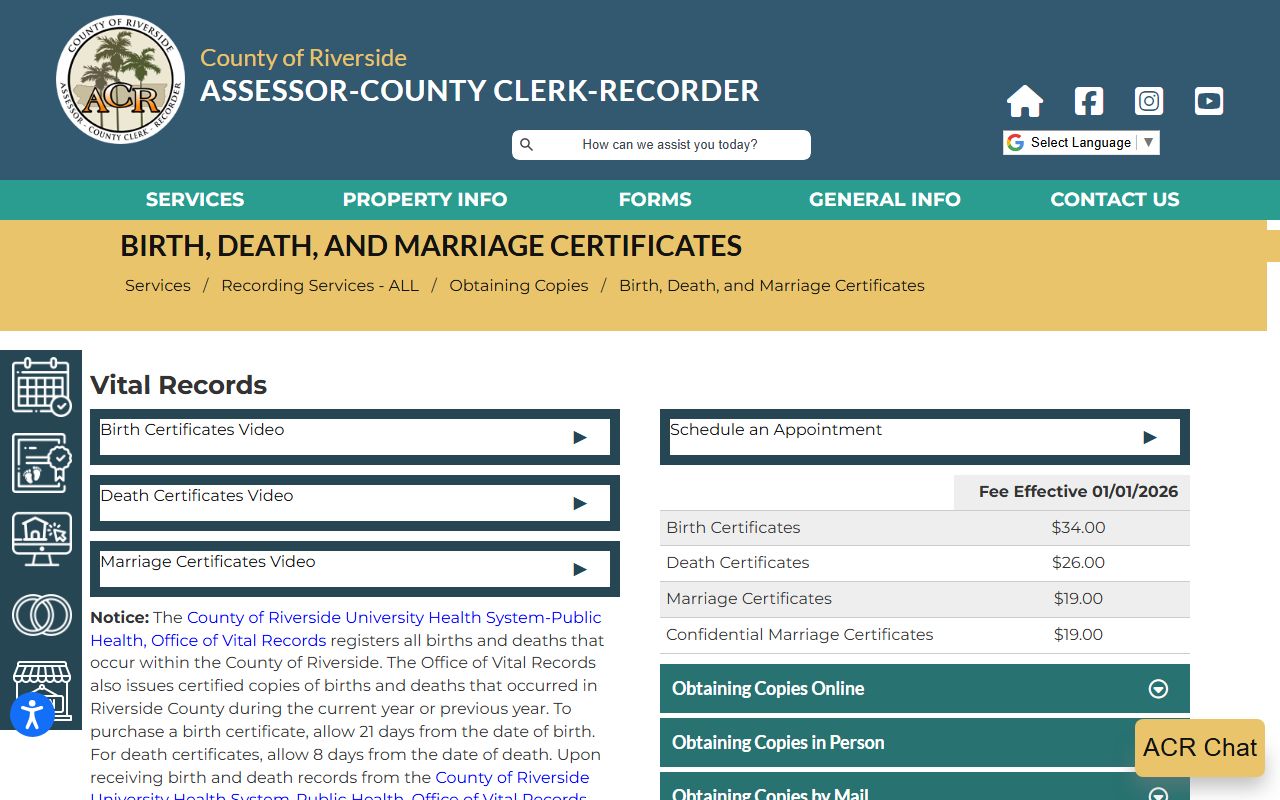
Riverside County accepts vital records requests at offices in Riverside, Palm Desert, Temecula, and other locations. The Temecula office serves southwest Riverside County including Murrieta. Birth certificates cost thirty one dollars. Death certificates run twenty six dollars. Marriage certificates cost nineteen dollars. Processing times vary from same day for walk-in service to two weeks for mail requests.
Request informational copies for genealogy research rather than certified copies. Informational copies do not require notarized forms and work perfectly for family history documentation. They cost the same but process faster because you skip notarization. Only close relatives need certified copies for legal purposes under California Health and Safety Code Section 103526.
Murrieta incorporated in 1991, so earlier vital records appear under general Riverside County sources. The area was rural ranch and agricultural land before suburban development began in the 1980s. Search county records for events before city incorporation under township or precinct designations.
Murrieta Library Local History Collections
The Murrieta Public Library maintains local history materials documenting city development from hot springs resort to suburban community. Collections include city documents, historical photographs, maps, newspapers, and information about Murrieta families and businesses. The library provides access to materials for genealogy researchers.
City directories for Murrieta begin in the 1990s after incorporation. Earlier residents appear in general Riverside County directories or under Temecula Valley community listings. The library helps locate ancestors in pre-Murrieta records. Newspaper coverage includes regional publications serving southwest Riverside County.
Murrieta Hot Springs attracted visitors starting in the 1870s when Ezequiel Murrieta developed the springs into a resort. Early hotel registers, visitor lists, and resort records document families who vacationed or worked at the springs. Some families who visited the hot springs later settled in the area permanently. Resort operations continued into the 1980s before residential development transformed the valley.
Historical photographs show Murrieta development from open ranch land to built community. The library collection includes images of the hot springs resort, early agricultural operations, and modern suburban growth. These photographs help visualize where ancestors lived during different development periods.
Temecula Valley Historical Society
The Temecula Valley Historical Society preserves records for southwest Riverside County including Murrieta area materials. Collections include ranch records, business files, photographs, and documents about valley development. Researchers can access materials about families who lived in the Temecula Valley before and after Murrieta incorporation.
Early Temecula Valley land records trace property ownership from Mexican land grant periods through American settlement. Rancho Temecula and other land grants covered the valley. Deed records, homestead applications, and property transfers help identify when families arrived and where they lived. Water rights records are important for understanding early settlement patterns in this semi-arid region.
Agriculture dominated the valley economy for decades. Cattle ranching, grain growing, and later wine grape cultivation employed valley residents. Ranch employment records and agricultural census schedules help trace farming families. The wine industry continues today with many wineries operating in the Temecula Valley.
Church records supplement civil vital records for valley families. Catholic, Protestant, and other congregations kept baptism, marriage, and burial records. These church registers often include more detail than government certificates. Contact individual churches or the historical society for guidance on accessing religious records from different time periods.
Murrieta Cemetery Records
Cemetery records provide burial information for Murrieta area families. Temecula Public Cemetery and other valley burial grounds serve the region. Cemetery office records include burial dates, plot locations, and family information. Some older burials appear in small community or family cemeteries that may no longer be actively maintained.
Inland Memorial in Wildomar and other nearby cemeteries also serve Murrieta residents. Cemetery files supplement death certificates with additional family details. Some families chose burial in other Riverside County cemeteries or maintained connections to burial grounds in their states of origin. Check multiple locations when researching family burials.
Military veterans may be buried at Riverside National Cemetery. Veterans Administration burial benefits allow eligible service members and spouses to be interred at national cemeteries. Riverside National Cemetery maintains detailed interment records including military service information.
Genealogy Research Tips for Murrieta
Murrieta incorporated relatively recently in 1991. Most genealogy research involves identifying families before city formation under earlier community designations. Focus on Riverside County vital records for births, deaths, and marriages. Then work backward to identify where families lived before moving to southwest Riverside County.
Many Murrieta families moved from other parts of California during the 1990s and 2000s housing boom. Rising home prices in San Diego and Orange counties drove families to seek affordable housing in Riverside County. Trace families backward using voter registration, school enrollment, and utility connection records. Previous addresses help locate earlier vital records and family information.
Military connections influence many Murrieta families. Camp Pendleton in San Diego County and other regional military installations brought service members to Southern California. Veterans settled in Murrieta after discharge or retirement. Military records supplement civilian vital records for tracing veteran families. The National Archives holds personnel files for former service members.
School records help trace families with children. Murrieta Valley Unified School District maintains enrollment files, yearbooks, and student records. Schools provide important documentation for families who moved frequently during the suburban growth period. Yearbooks confirm family connections and provide photographs.
Other Riverside County Cities
Riverside County includes multiple cities with populations over one hundred thousand. Researchers with Murrieta ancestors should check nearby cities where families maintained connections or moved between communities.
Cities near Murrieta include Temecula, Riverside, Corona, Moreno Valley, and Jurupa Valley. All use the Riverside County Assessor-County Clerk-Recorder for vital records but maintain separate local history collections and library resources.