
Tulare County Genealogy Records
Genealogy records for Tulare County document families in California's San Joaquin Valley since 1852. The County Clerk-Recorder in Visalia maintains vital records for births, deaths, and marriages occurring in this agricultural region. With about 473,000 residents, Tulare County ranks among California's top farming areas. Records from pioneer ranching days through modern times trace families who worked citrus groves, cotton fields, and dairies. Researchers can access genealogy records through the Visalia office, online portals like Permitium, or mail requests. Early records are incomplete due to voluntary registration before mandatory vital statistics laws took effect in 1915.
Tulare County Quick Facts
Tulare County Clerk-Recorder Office
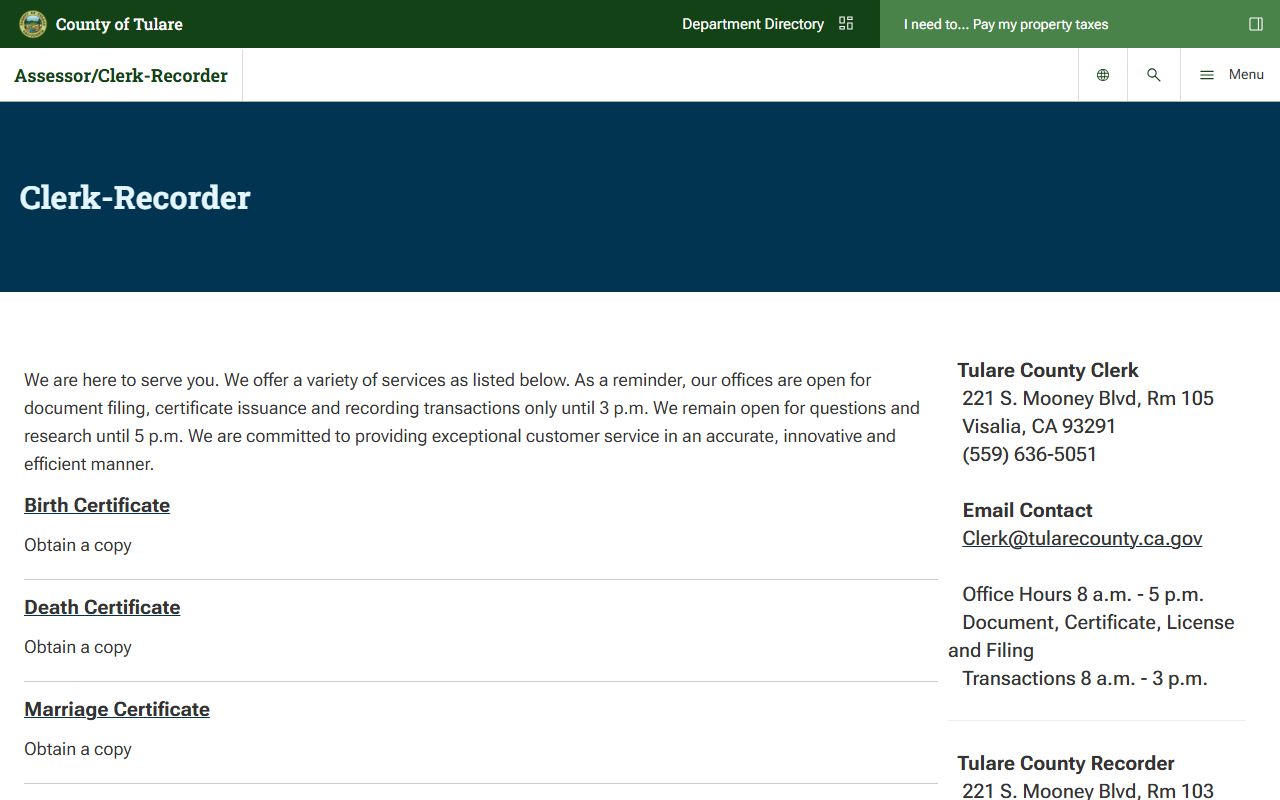
The Tulare County Clerk-Recorder serves as the primary source for genealogy records. This office keeps birth and death certificates for events in the county and marriage records for licenses issued here. The recorder operates from the county civic center in Visalia, the county seat since 1853.
Records date back to 1852 when Tulare County was created from part of Mariposa County. Early vital records are sparse since California had no statewide registration until 1905 and did not require it until 1915. Many births and deaths went unrecorded in pioneer times. Genealogy researchers should expect gaps in records from the 1850s through 1910s.
| Address |
County Civic Center 2900 West Burrel Avenue Visalia, CA 93291 |
|---|---|
| Phone | (559) 624-7302 |
| Hours | Monday through Friday, 8:00 AM to 5:00 PM |
| Online Portal | Online Request Portal |
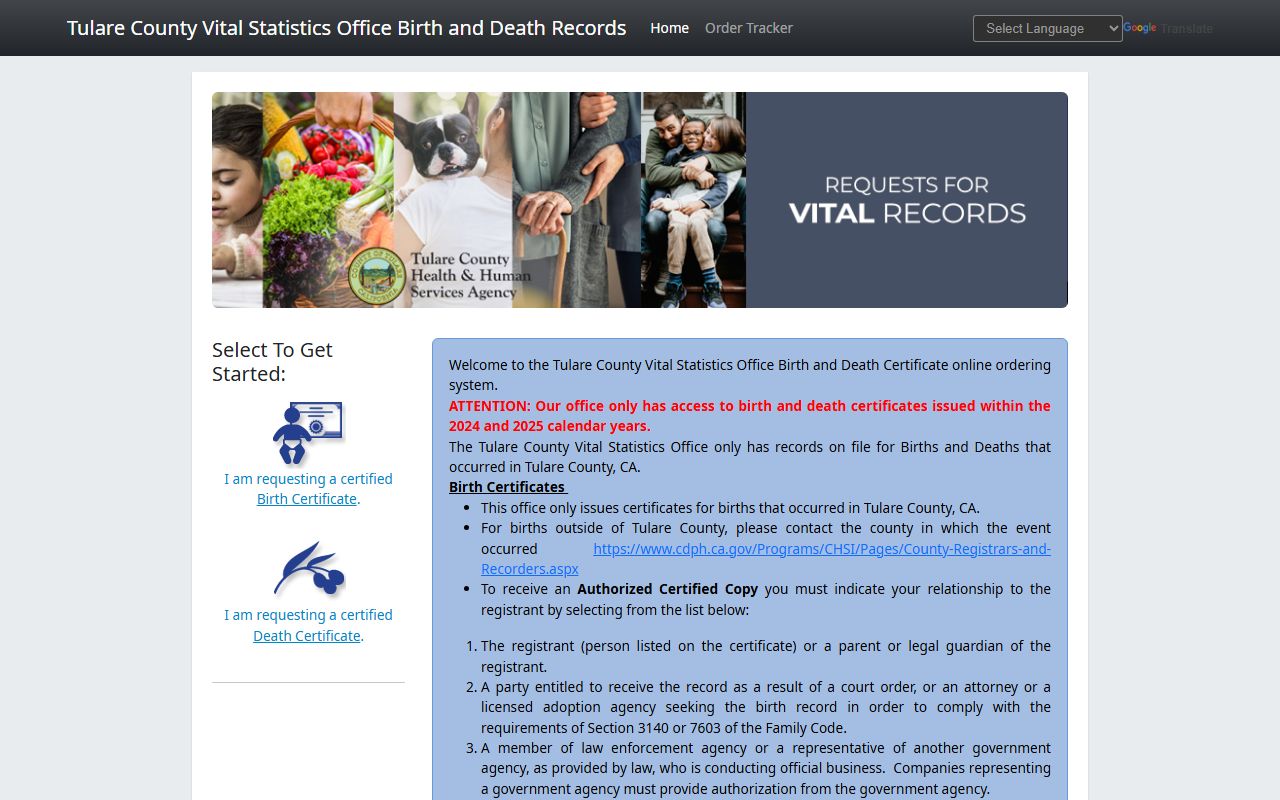
Staff can search electronic databases and older microfilm records. The county offers online ordering through Permitium. This system accepts credit cards and processes requests digitally. In-person visits provide same-day service when records are readily available.
Birth, Death, and Marriage Records
Birth certificates show a child's name, birth date and place, parents' names and ages, and other family information. Death records include the deceased person's name, death date, age, birthplace, parents' names, and usually cause of death. Marriage records show both spouses with marriage date and location. These vital records help genealogy researchers document family lines.
Current fees are thirty one dollars for birth certificates, twenty six dollars for death certificates, and nineteen dollars for marriage certificates. These prices cover one certified copy. Genealogy researchers should request informational copies rather than certified copies. Informational copies work for family history and do not require notarized statements. Both copy types cost the same.
To order a record, provide the person's full name, date of the event, and location within Tulare County. Parents' names help for birth records. Additional details speed searches. Birth and death records take about three weeks to become available after the event is registered. Historical records are already on file.
The California Birth Index 1905-1995 provides free access to state birth indexes. Use this to verify a Tulare County birth occurred before ordering certificates. The index shows names, dates, and counties but not full certificate details.
How to Order Tulare County Genealogy Records
Three methods exist to obtain vital records. Visit the Visalia office during business hours. Bring photo ID and details about the record you want. Staff will search their systems and make copies if they find a match. In-person requests often receive same-day service when the office is not too busy.
Online ordering through the Tulare County Permitium portal provides convenience. Visit the online request portal to submit applications and pay by credit card. The system charges a processing fee on top of the county fee. Orders are processed during business hours. Certificates mail within one to two weeks.
Mail requests work for people who prefer traditional methods. Download application forms from the county website or call to have them mailed to you. Fill out forms completely. Include payment by check or money order. Send to the Visalia address. Processing takes one to two weeks. The county keeps fees even if no record is found since fees cover search costs.
Tulare County Genealogy Resources
The Tulare County Library system has genealogy materials at several branches. The Visalia Branch has the largest collection with books, microfilm, and digital resources. Local history materials include city directories, newspapers, and family files. Library staff can guide genealogy researchers to relevant materials about Tulare County families.
The Tulare County Museum has historical archives relevant to genealogy research. Their collection includes photographs, maps, manuscripts, and documents about county history. The museum focuses on agricultural heritage and pioneer families who settled the valley.
Cemetery records provide valuable information for family history. Tulare County has many cemeteries including the Visalia Public Cemetery dating to the 1850s. Find A Grave indexes thousands of local burials with headstone photographs. Physical cemetery visits can reveal family plot arrangements and inscriptions with dates and relationships.
The California State Archives in Sacramento holds some Tulare County records. Their collection includes county records transferred to state custody. Visit the archives or contact staff to learn what Tulare County materials they have for genealogy research.
Tulare County History and Records
Tulare County was created in 1852 from part of Mariposa County. The county name comes from Tulare Lake, which once covered vast areas of the valley floor. Early settlers raised cattle on the rich grasslands. Mining in the Sierra foothills brought some prospectors. Agriculture became the economic foundation once irrigation systems were developed.
The Southern Pacific Railroad reached Tulare County in the 1870s, spurring growth. Towns sprang up along the rail line. Wheat dominated early farming. Citrus groves planted in the late 1800s transformed the landscape. Irrigation districts formed in the early 1900s to bring Sierra Nevada water to valley farms.
Immigration patterns shaped the population. Mexican families worked harvests. Portuguese families ran dairies. Japanese families farmed vegetables. Dust Bowl migrants arrived in the 1930s. Each ethnic group left different types of records that supplement official vital records for genealogy research.
Modern Tulare County produces more agricultural value than almost any other American county. Dairy, citrus, grapes, and cotton dominate. Recent genealogy records are more complete than those from pioneer times due to modern record-keeping systems.
Tips for Tulare County Genealogy Research
Start with family knowledge. Talk to older relatives about names, dates, and places. Write everything down. Work backward one generation at a time. Do not skip ahead to distant ancestors until you have solid connections through each generation.
Check both county and state sources. The California Department of Public Health has records from 1905 forward. Tulare County has some earlier records. If one source fails, try the other. Different filing systems mean one might have what the other lacks for genealogy research.
Use newspapers when vital records are missing or incomplete. The California Digital Newspaper Collection includes Tulare County newspapers from the 1800s forward. Obituaries, marriage announcements, and local news provide family details not found in official vital records.
Consider agricultural records for farming families. Land deeds, water rights documents, and irrigation district records help place families in specific locations. The California Health and Safety Code Section 103526 governs vital records access. These property records supplement vital records to build complete family histories.