
Monterey County Vital Records
Monterey County genealogy records include birth certificates, death records, and marriage licenses maintained by the County Assessor office in Salinas. These vital records help trace family history from California's Spanish colonial period through present day. Researchers can order genealogy records by visiting the office, mailing applications, or calling for assistance. Monterey County formed in 1850 as one of California's original counties with some records predating statehood. California statewide vital records began July 1905, but earlier Monterey County records exist. Begin your Spanish California and agricultural family research with birth, death, and marriage documents from Salinas, Monterey, Seaside, and other county communities.
Monterey County Quick Facts
County Assessor Vital Records Services
The Monterey County Assessor handles vital records for genealogy research. This office keeps birth certificates, death records, and marriage licenses filed in the county. The main office is in Salinas at the county government center. Staff assist researchers Monday through Friday during business hours.
Records date from 1850 when Monterey County formed as one of California's original twenty seven counties. The county seat moved from Monterey to Salinas in 1873. Earlier Spanish and Mexican period records exist at the California State Archives and through Catholic mission registers. Monterey was California's capital under Spanish and Mexican rule, creating rich historical documentation.
Visit in person for same day service on many records. Bring photo ID and exact event details. The office is in downtown Salinas with nearby parking. Call ahead to confirm hours and current fees. Staff can search files by name if you provide approximate dates.
Birth Certificates in Monterey County
Birth certificates cost thirty one dollars per copy. Monterey County has birth records from 1850 forward, though early years are incomplete. California did not require birth registration until 1915. Many births before that year went unrecorded. Agricultural workers had particularly low compliance with registration laws. Seasonal migrants often left no records.
Missing birth records can be supplemented with alternate sources. Census schedules starting in 1850 list ages and birthplaces. Catholic mission registers at Carmel Mission and San Antonio de Padua Mission contain baptism records back to 1770. Church records from Monterey, Salinas, and other communities name parents. Family bibles recorded births when government systems failed.
Request informational copies for genealogy work. These do not require notarized applications. The informational copy has all birth details but includes a legend stating it cannot establish identity. That limitation does not affect family history research. Informational copies cost the same as certified copies but process faster.
Birth certificates list parents' names, ages, birthplaces, and occupations. Mother's maiden name appears on the record. Hospital or location of birth is noted. For agricultural families, occupation often appears as farm worker or laborer. These details help trace immigrant and migrant worker origins.
Death Records from Monterey County
Death certificates cost twenty six dollars from Monterey County. The county maintains death records for anyone who died within its boundaries. Death records list birthplace, parents' names, cause of death, and burial location. This information helps genealogy by confirming identities and locating earlier records in other states or countries.
Historical death records document diverse populations. Spanish and Mexican era families, Chinese immigrants, Japanese farmers, Italian fishing families, and agricultural workers from Mexico all appear in Monterey County death records. Cause of death information reflects occupational hazards. Fishing accidents, agricultural injuries, and military deaths at Fort Ord are documented.
Death records over fifty years old are public in California. Recent deaths have access limits for certified copies. Informational copies are available to anyone for genealogy regardless of relationship. These contain the same data as certified copies but are marked as not valid for establishing identity.
Monterey County has numerous historic cemeteries. Death certificates list burial locations. Mission burial grounds, military cemeteries, and ethnic cemeteries all hold genealogy information. San Carlos Cemetery in Monterey, Salinas Cemeteries, and many smaller burial grounds have registers with additional family details.
Marriage Licenses and Records
Marriage certificates cost nineteen dollars from Monterey County. The county has marriage records from 1850 forward. Earlier Spanish and Mexican era marriages are recorded in Catholic mission registers. These church records sometimes provide the only documentation of early Monterey County marriages.
Marriage records list names, ages, birthplaces, parents' names, and occupations for both parties. Some older licenses note prior marriages and children. This makes marriage records extremely valuable. One document can provide information about six people across three generations when both sets of parents are named.
Marriage licenses are filed where issued, not where ceremonies occurred. A Monterey County license is on file regardless of wedding location. Confidential marriages since 1971 are sealed. All other marriage licenses are public. Search the marriage index before ordering copies to confirm records exist.
Note: Contact the county that issued the license, not where the wedding ceremony took place.
Genealogy Research Resources
Monterey County Free Libraries have local history collections for genealogy research. The Salinas branch holds extensive Monterey County materials including old newspapers on microfilm, city directories, cemetery indexes, and compiled family histories. Branch libraries in Monterey, Seaside, and other communities also have local materials. Staff provide reference assistance during open hours.
Monterey History and Art Association maintains archives with photographs, maps, business records, and family papers. Their collections cover both city of Monterey and county history. The association assists researchers by appointment. Their Spanish and Mexican era materials are particularly strong for early California family research.
Carmel Mission and San Antonio de Padua Mission have baptism, marriage, and burial registers dating to the Spanish colonial period. Mission records are now at various archives. Some are at the Santa Barbara Mission Archive Library. Others are at the Bancroft Library in Berkeley. These mission records are essential for researching Spanish California ancestors.
Fort Ord operated from 1917 to 1994 as a major Army base. Military personnel records, base newspapers, and unit histories mention thousands of families. National Personnel Records Center in St. Louis holds federal military records. Local historical societies have Fort Ord materials.
Monterey County Historical Background
Monterey County was one of California's original counties in 1850. The county takes its name from Monterey Bay, named by Spanish explorer Sebastian Vizcaino in 1602. Spanish settlement began with founding of San Carlos Mission and Monterey Presidio in 1770. Monterey served as capital of Spanish and Mexican California. This colonial heritage created documentation predating most California counties.
The county seat moved from Monterey to Salinas in 1873 as agricultural development shifted population inland. Lettuce, artichokes, and other crops made Monterey County the Salad Bowl of the World. Agricultural work attracted immigrant and migrant workers. Italian, Portuguese, Japanese, Filipino, and Mexican families all contributed to county agriculture and appear in genealogy records.
Fishing industry in Monterey and other coastal communities employed Italian, Portuguese, Chinese, and Japanese families. Cannery Row sardine industry peaked in the 1930s and 1940s. Fishing and cannery work shaped many family histories. Check employment records, union files, and ethnic community organizations for ancestors in fishing trades.
Chinese immigrants faced severe discrimination including anti-Chinese riots and exclusion. Many Chinese records were destroyed or hidden. Chinese genealogy research requires creativity. Look for merchant association records, Tong records, and Chinese language newspapers that survive in archives.
How to Order Monterey County Records
Multiple options exist for obtaining genealogy records from Monterey County. Visit the assessor office in Salinas. Mail a completed application with payment. Call the office to discuss record availability. Each method has different processing times and requirements.
In person visits provide immediate service if records are located. The office is in the county government center in Salinas. Bring government issued photo ID and exact event details. Staff will search files and provide same day copies when possible. Payment by cash, check, or money order is accepted at the counter.
Mail requests require application forms available on the county website or by calling the office. Complete all sections with required information. Include payment by check or money order made payable to Monterey County Assessor. Add a self-addressed stamped envelope. Do not mail cash. Processing takes one to two weeks plus postal transit time.
Notarization is needed for certified copies but not informational copies. Request informational copies for genealogy work to avoid notary requirements. These copies contain identical information as certified copies but are marked as not valid for establishing identity. This marking does not affect their value for family history research.
California State Genealogy Resources
The California Department of Public Health Vital Records maintains statewide birth and death records from July 1905 to present. Order from the state if you are uncertain which county holds a record. State indexes cover all California counties. Processing takes approximately fifteen business days.
FamilySearch offers free access to California vital record indexes. The California Birth Index 1905-1995 includes Monterey County births. Search these free indexes before ordering certificates to confirm records exist. This saves time and money in genealogy research.
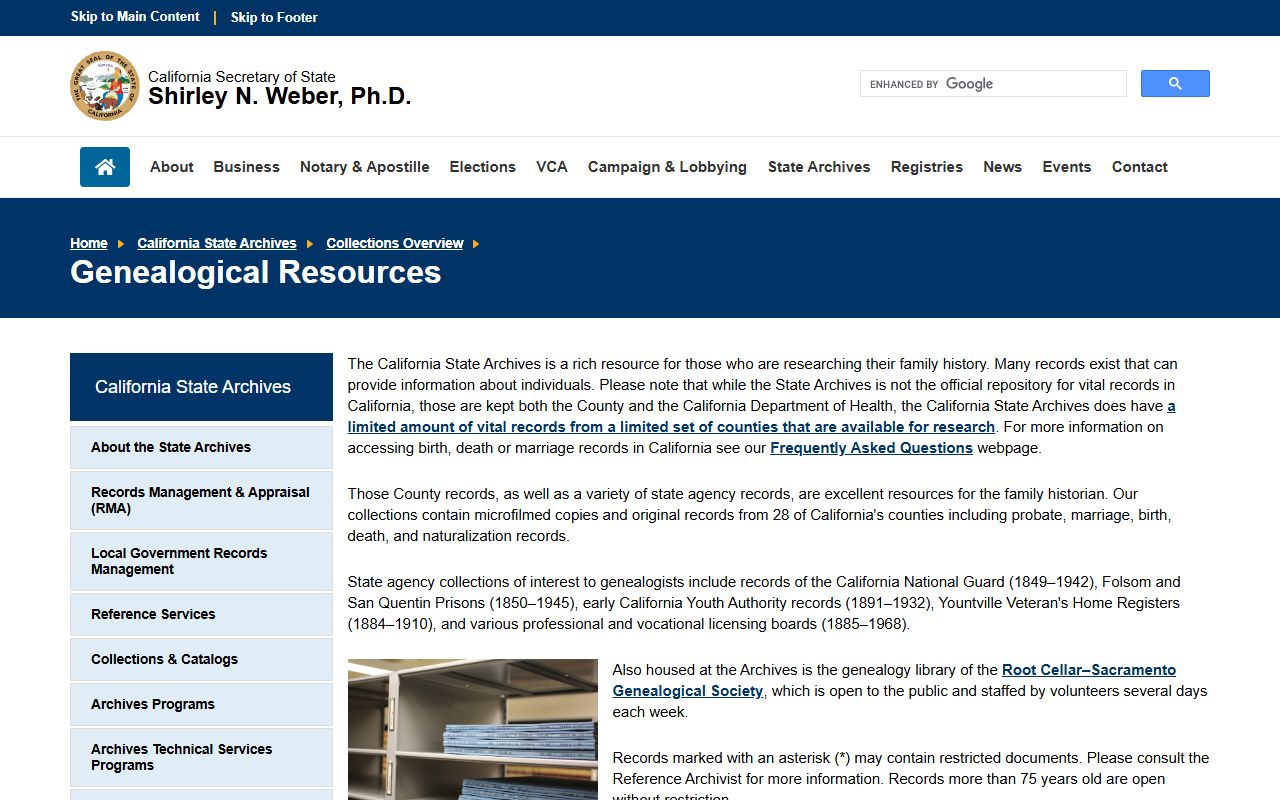
The California State Archives in Sacramento holds broader genealogy collections including Spanish and Mexican era records. Their holdings include census schedules, court cases, and government records mentioning Monterey County residents. The archives reading room is open weekdays for public research.
Adjacent Counties for Research
Monterey County borders Santa Cruz, San Benito, Fresno, Kings, and San Luis Obispo counties. Families moved between these areas for work and land. Check neighboring county records if ancestors lived near borders. Agricultural workers often moved seasonally between Central Coast and Central Valley counties.
Nearby counties: Santa Cruz County, San Benito County, Kings County, San Luis Obispo County